2026 Midterm Health Care Analysis
State of Play
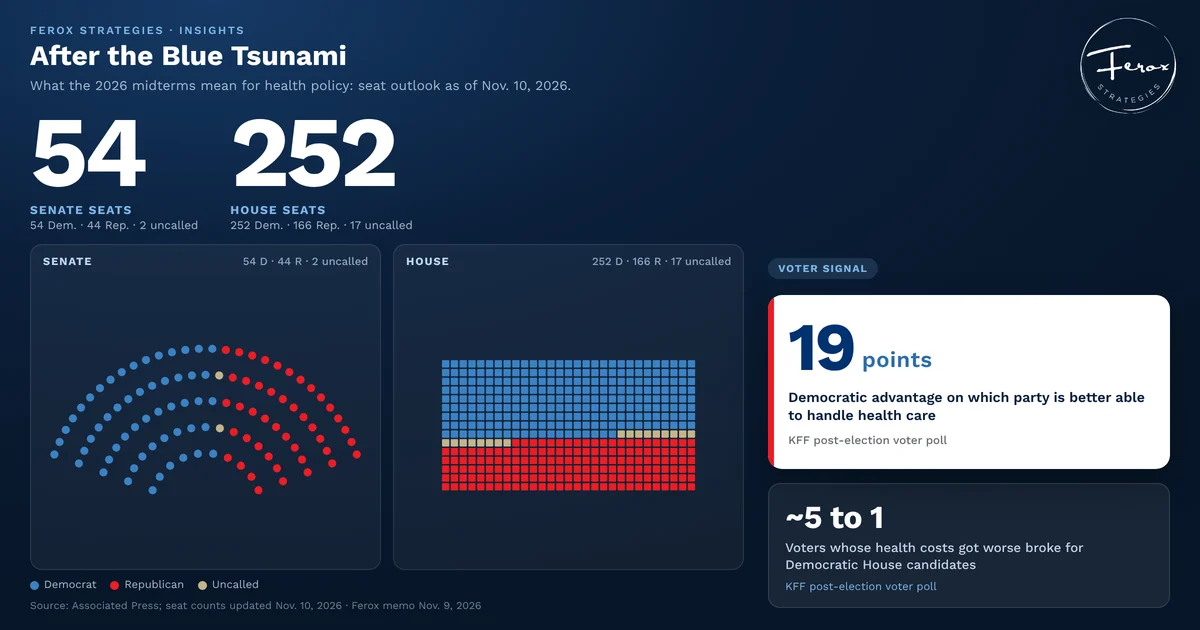
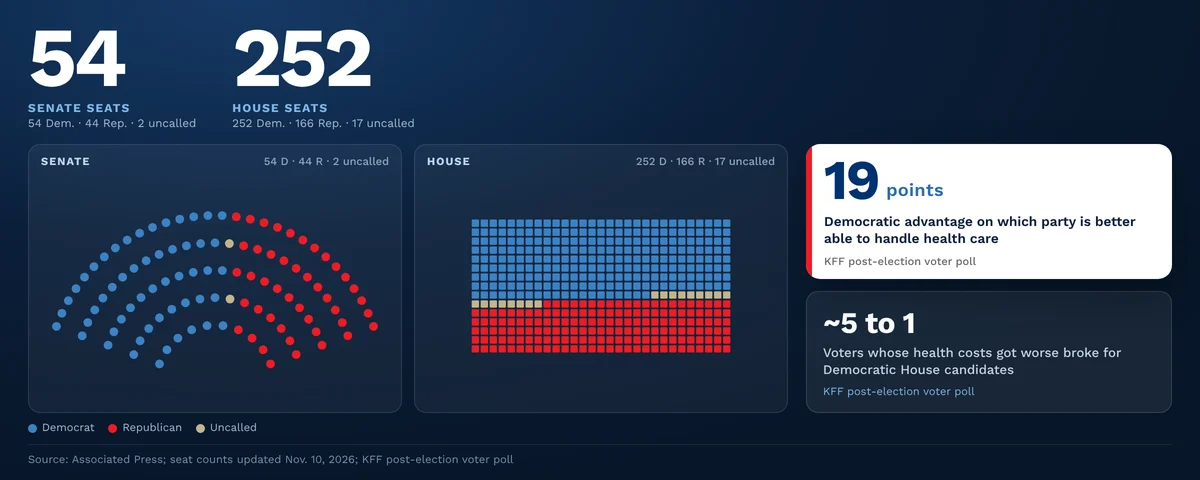
Tuesday’s results have significant implications for several corners of federal health care policy. While votes are still being counted and several races remain uncalled, Democrats are on track to win at least 54 seats in the Senate and at least 254 seats in the House, according to the Associated Press as of Monday afternoon.
Although health care ultimately became more sidelined as an issue in the election, it is clear midterm voters believe the Democratic Party is better positioned to deal affordability issues in the sector. KFF’s post-election voter poll found that voters gave Democrats a 19-point advantage on which party is better able to handle health care, and voters who said their health costs had gotten worse broke for Democratic House candidates by roughly five to one. Democratic members will read these numbers as a mandate on health care affordability, and we expect them to structure several early agenda items around this framework, which were already signaled from recent Senate Finance and House policy work products.
Ferox has outlined below how the results reshape the lame duck, health committees composition, and paths forward on the major health policy areas for the 120th Congress.
Lame Duck
House Republican leadership is scrambling. Speaker Mike Johnson (R-LA) announced Wednesday morning that he will not run for Minority Leader, and Majority Leader Steve Scalise (R-LA) and Judiciary Chairman Jim Jordan (R-OH) have both announced bids. Leadership elections are still set for next week. Senate Republican leadership is more settled, with John Thune (R-SD) well positioned to retain his post despite an expected challenge from Rick Scott (R-FL). Democratic leadership elections are being held the week of November 16, but we do not expect any changes at the highest levels.
The sooner these races wrap up, the better, as Congress still has a significant to-do list before the 119th Congress adjourns. The highest priority health care item is the set of public health and Medicare extenders expiring at the end of the year, including physician pay, rural hospital payment adjustments, workforce program funding, and community health center funding. These expirations could provide the vehicle for a larger health package. However, we believe the likeliest scenario is a clean, short-term extension alongside the December government funding deadline that gets relitigated early in the 120th Congress.
Lame duck nominations will also have a health care component, as we expect Heidi Overton’s nomination for FDA Commissioner to come before the Senate. We have heard that all committees need to process their nominations before Thanksgiving to make way for a final nominations package, so we expect to know more about Overton’s timeline within the next two weeks.
Committees of Jurisdiction 120th
House Committees
With Democrats flipping the lower chamber, Rep. Frank Pallone (D-NJ) is set to lead the Energy and Commerce Committee in the 120th Congress, and Rep. Kathy Castor’s (D-FL) hold in a redistricted Florida seat makes it likely she will take the gavel of the Energy and Commerce Health Subcommittee. We expect Brett Guthrie (R-KY) and Morgan Griffith (R-VA) to continue in their roles as Ranking Members of the full Committee and Health Subcommittee, respectively.
Committee ratios will shift as well. After the 2014 midterms, when the GOP won a House majority similar in size to what Democrats are projected to hold now, the 114th Congress opened with 31 Republicans and 23 Democrats on Energy and Commerce. We expect roughly the reverse this time. Even after retirements and election losses, the GOP side may need to shed additional members unless leadership expands the committee.
Turnover on E&C looked to be significant even before ballots were cast on Tuesday. Eight members were already set to leave through retirements, bids for higher office, and primary defeats including Reps. Diana DeGette (D-CO), Jan Schakowsky (D-IL), Robin Kelly (D-IL), Marc Veasey (D-TX), Neal Dunn (R-FL), Buddy Carter (R-GA), Dan Crenshaw (R-TX), and John James (R-MI). Tuesday added four more Republican departures, with Reps. Tom Kean (R-NJ), Mariannette Miller-Meeks (R-IA), and Gabe Evans (R-CO) losing their races and Rep. Richard Hudson (R-NC) conceding on Wednesday. Rep. Gus Bilirakis (R-FL) held his redrawn seat, while Rep. Darren Soto (D-FL) holds a narrow lead in a race that has not been called and Rep. Doris Matsui (D-CA) leads her intraparty challenger.
The math cuts very differently for each party. If Soto and Matsui hold on, Democrats return roughly 20 members and could need 10 or more new members to fill out a majority ratio. Republicans return roughly 22, but this variability leaves room for one new Republican at most, or potentially none and might even necessitate the removal of current members.
Seats on the Democratic side are awarded by the Steering and Policy Committee, which weighs seniority and regional balance. Democrats we are tracking for E&C seats include:
- Rep. Sarah McBride (D-DE)
- Rep. Don Davis (D-NC)
- Rep. Melanie Stansbury (D-NM)
- Rep. Maxine Dexter (D-OR)
- Rep. Jill Tokuda (D-HI)
- Rep. Eric Sorensen (D-IL)
- Rep. Luz Rivas (D-CA)
- Rep. Gabe Vasquez (D-NM)
- Rep. Vicente Gonzalez (D-TX)
Davis, Vasquez, and Gonzalez all survived competitive races on Tuesday, so the full list remains in play, and a few names from the unusually large freshman class could surface as well. On the Republican side, we believe the preference for who would occupy the (potentially) open single seat would be:
- Rep. Bob Onder (R-MO): A practicing physician who previously served in the Missouri Senate. His medical background makes him a natural fit for the Health Subcommittee and the strongest GOP candidate in our view.
Rep. Eric Burlison (R-MO) and Jessica Steinmann, the Representative-elect from Texas’ 8th District, have also expressed interest, but we see both as long shots for the slot.
Over at Ways and Means, Richard Neal (D-MA) will take over the committee, but Health Subcommittee leadership is still in flux because Mike Thompson (D-CA) remains locked in a close race against a Democratic challenger. If Thompson loses, we have heard Rep. Terri Sewell (D-AL) could take over that gavel, although Linda Sánchez (D-CA) will have right of first refusal. Given Sewell’s work product from the Cost-of-Living Healthcare Working Group, she would be positioned to hit the ground running on priorities in the 120th Congress. With Vern Buchanan’s (R-FL) retirement, we project Adrian Smith (R-NE) to become Ranking Member of the Health Subcommittee.
Ways and Means will also see an influx of new Democrats, and the members we have heard are positioning for open seats include:
- Rep. Morgan McGarvey (D-KY)
- Rep. Marilyn Strickland (D-WA)
- Rep. Gabe Amo (D-RI)
- Rep. Tim Kennedy (D-NY)
- Rep. Andrea Salinas (D-OR)
- Rep. Johnny Olszewski (D-MD)
- Rep. Hillary Scholten (D-MI)
- Rep. Kristen McDonald Rivet (D-MI)
- Rep. Emilia Sykes (D-OH)
McDonald Rivet, Sykes, and Salinas all held their seats on Tuesday.
For clients with ERISA equities, Bobby Scott (D-VA) appears set to lead the Education and Workforce Committee, which we expect will once again be renamed Education and Labor. He will face challenges for the gavel from both Suzanne Bonamici (D-OR) and Jahana Hayes (D-CT), but we expect him to fend them off. Mark DeSaulnier (D-CA) has already had his race called and is expected to chair the Health, Employment, Labor, and Pensions Subcommittee.
Senate Committees
The HELP Committee picture got complicated on Tuesday night. Democratic wins pushed the party into the Senate majority and, in all likelihood, put Sen. Bernie Sanders (I-VT) in the HELP chairmanship for the 120th Congress. The bigger surprise is on the Republican side, where losses by Susan Collins (R-ME) and Roger Marshall (R-KS) mean the next HELP Ranking Member could be Josh Hawley (R-MO).
A few dominoes need to fall for that to happen, but each is entirely possible. Rand Paul (R-KY) has right of first refusal, but he passed on the HELP gavel at the start of this Congress in favor of outgoing Sen. Bill Cassidy (R-LA), and we think he would prefer to stay atop HSGAC as Ranking Member. Lisa Murkowski (R-AK) is also positioned ahead of Hawley, but Collins’ loss opens the top Republican spot on Appropriations, which we anticipate Murkowski will take. The most credible obstacle to a Hawley ranking membership is Tim Scott (R-SC), who would also need to pass on the position. Scott is currently set to be Ranking Member on Banking, but Senate leadership may push him to take HELP to avoid the complications Hawley could create in that role. A Sanders and Hawley pairing would make HELP the most populist venue stakeholders have faced in years.
Whoever lands the top Republican slot will be leading a largely new bench. Five of HELP’s 12 Republicans will not return: Chairman Cassidy, Collins, Marshall, Sen. Jon Husted (R-OH), who lost his special election to Sherrod Brown, and Sen. Tommy Tuberville (R-AL), who ran for governor. HELP Democrats return largely intact, so we expect the new majority to add only one or two new Democrats, while Republicans will be filling several open seats with members new to the committee’s jurisdiction. Marshall’s loss also clears the way for Sen. Ed Markey (D-MA) to chair the Primary Health and Retirement Security Subcommittee.
Senate Finance is less dramatic. Membership will turn over, but Ron Wyden (D-OR) and Mike Crapo (R-ID) will simply swap roles, with Wyden taking the gavel and Crapo moving to Ranking Member.
On the Republican side, turnover includes, Sens John Cornyn (R-TX) and Cassidy who lost their primaries; Sen. Marsha Blackburn (R-TN) who was elected governor of Tennessee; and Sen. Thom Tillis (R-NC) who is retiring. Sen. Tina Smith (D-MN) is the lone departing Democrat due to retirement. With the ratio flipping, Democrats will add several new members, and we would watch Senator-elect Sherrod Brown (D-OH), a former Finance member, as a natural candidate. On the Health Care Subcommittee, we expect Sens. Maggie Hassan (D-NH) and Todd Young (R-IN) to remain the top members, with Hassan taking the gavel.
Drug Pricing
Drug pricing policy figures to be a core component of the Democratic health care agenda in the 120th Congress. Unlike other prominent priorities, this area is ripe for bipartisan compromise, especially if Democratic lawmakers can sell these types of policies as collaborative wins with the Trump Administration.
Medicare Drug Price Negotiation
In all likelihood, the first drug pricing policy item that Democrats will offer up next Congress is an expansion of Medicare’s Drug Price Negotiation Program (MDPNP). This policy would have a few different pillars that include:
- Increasing, or simply removing, the cap on the number of drugs eligible for negotiation per year.
- Extending Maximum Fair Prices set through MDPNP to the individual and commercial insurance markets.
- Extending inflation rebates to additional insurance markets.
- Altering the timeline for drug negotiation paired with new incentives for biosimilar and generic drug development that help mitigate market distortion from the current selection timelines.
Less likely, but still contained within the Senate Finance Committee’s Drug Pricing RFI from June, is some consideration of reference pricing within the MFP framework. However, given the Trump Administration’s support of such policies, Democratic lawmakers could consider doing something more robust outside the MDPNP with GOP support. If a deal with the White House does not come together, expect Democrats to use the next two years to set the stage for a Medicare negotiation expansion in 2029.
Furthermore, a Democratic Congress effectively ends the near-term prospects for “narrow” IRA fixes, including the MINI Act and the EPIC Act. The MINI Act in particular faces opposition from incoming E&C Chairman Pallone. We would expect Democrats to resist any further exclusions from negotiation; however, they might consider revisiting how MDPNP is impacting drug utilization in Medicare Part B if the MFP + 6% reimbursement framework ends in disaster for providers and/or Medicare beneficiary access to certain oncology drugs.
The orphan drug exclusion expansion enacted through OBBBA will continue to act as a political/legislative target for Democratic lawmakers. Democratic members in both chambers, even those we would consider friendly to industry, have raised questions about the delay for certain blockbuster medications tied to the law. Repeal would require Trump’s signature, so it likely isn’t in play, but we do not want to discount the inconsistency of the President, especially if Democrats are able to sell a large IRA package such as the Lowering Drug Costs for American Families Act to Trump through the lens of its reference pricing provisions.
MFN
To date, the Trump Administration has built its MFN framework entirely outside of Congress. However, throughout the ongoing effort to codify the proposed GLOBE and GUARD models, the Administration was actively searching for champions to put these pricing mechanisms into statute. With new leadership on health care committees of jurisdiction, the Administration could be better positioned to achieve codification than it was under the GOP trifecta.
While the Administration would likely still face an uphill battle to get the House Energy and Commerce Committee to consider MFN proposals, it will find extremely willing partners on the Senate HELP Committee. Sen. Josh Hawley (R-MO), the potential next Ranking Member of HELP, has previously introduced MFN legislation (the Fair Prescription Drug Prices for Americans Act - S.1587) alongside Sen. Peter Welch (D-VT). Sen. Bernie Sanders (I-VT), the projected Chair of the Committee, has long been a proponent of international reference pricing.
Potentially, a negotiation between the Administration and the Sanders Team at HELP could break down along the following lines:
- Dems would want statutory parameters for MFN pricing that replace current one-off agreement frameworks and could potentially request an extension of MFN pricing beyond Medicare and Medicaid into the commercial market.
- The White House and supportive GOP members would want codification of models that they can brand as a permanent win, ideally with credit for the existing agreements and TrumpRx, without reopening the entirety of the IRA.
Codification on the Administration’s terms remains unlikely, but a narrower deal is more plausible than previously anticipated due to the change in Senate control and potential committee leadership.
In the meantime, the more immediate exposure for companies with MFN agreements is Democratic oversight, while others should be alert that the GUARD model at OMB could be released with a different set of exemptions than the finalized GLOBE model.
PBM and Patent Reforms
In 2026, Congress and the Administration were both extremely active on the PBM front, and we expect this largely bipartisan activity to continue into 2027 and over the 120th Congress. While some GOP champions on PBM reform did not survive the Blue Tsunami, GOP opponents of previous reforms also lost their seats, so we’ll call momentum on the GOP congressional side a wash.
Meanwhile, Democrats in both chambers have provided an outline of their potential PBM focal points in the 120th Congress. House Democratic scrutiny of PBMs looks most likely to take an anticompetitive lens. Proposals under consideration will cover topics such as prohibitions on PBM pharmacy ownership and practices that advantage affiliated pharmacies. In the Senate, Team Wyden will consider proposals that govern Medicare Part D plan sponsor contracts with PBMs, private label manufacturing, and the net cost of benefit management for plan sponsors.
We anticipate the Administration will support these efforts and continue to utilize DOL and CMS to put additional regulatory pressure on PBMs.
Patent reforms also figure to be revived as potential bipartisan drug pricing wins, especially as potential pay-fors in larger packages. Patent thicket and product-hopping bills are likely to resurface early next session and have already been identified by the Democratic Cost-of-Living Healthcare Working Group in the lower chamber as health care affordability solutions.
PDUFA and FDA
FDA Commissioner Nomination
Following up our lame duck preview above, we would expect Heidi Overton to be confirmed in this period, but the path is narrower than it looks. If Overton does not clear committee and the floor before the end of the session, her nomination is returned and a Sanders-led HELP would become the gatekeeper for any new nominee. In that scenario, we would expect Kyle Diamantas to remain acting commissioner well into 2027, as he would have a refreshed 210-day clock to serve.
For sponsors, the day-to-day FDA outlook is largely unchanged either way. Regardless of who leads the agency, we expect the CBER and CDER directors and the Rare Disease Innovation Hub to keep the Rare Disease Framework Initiative on track, along with the clinical trial reforms in Operation TrialBlazer, including the Expedited IND Pilot.
PDUFA VIII Reauthorization
We expect FDA to transmit the PDUFA VIII commitment letter to Congress on schedule in January, with hearings in both chambers by spring. The letter itself is unlikely to be reopened in any meaningful way; the real disagreements will be over the policies Congress attaches to it.
Energy and Commerce will likely move on reauthorization first. Reps. Pallone, Castor, and Griffith have all worked user fee packages before, and we would expect a bipartisan House bill by early summer. HELP is the wild card. Sanders has cast the lone Senate vote against multiple user fee reauthorizations and, as chair, will control the Senate vehicle. If Hawley ends up as Ranking Member, he will not provide much of a counterweight, given his own record as an outspoken industry critic. Sen. Sanders could potentially use the reauthorization as leverage on a handful of priorities such as:
- International reference pricing, which ties directly to the MFN codification negotiation discussed above and is the most likely place for a Sanders and White House deal to surface.
- Prescription drug importation, which he offered as an amendment during the 2022 HELP PDUFA VII markup.
- Pricing conditions on drugs developed with federally funded research.
- New guardrails on the Commissioner’s National Priority Voucher program, which Sanders and has already questioned.
- FDA independence, staffing levels, and conflict of interest provisions aimed at the Administration’s political leadership at the agency.
Few, if any, of these are likely to make it into a final bill, but they will likely slow down the Senate reauthorization process.
The reauthorization will still be the main vehicle for bipartisan FDA policy. Components of the Auchincloss and Griffith Faster Clinical Trials Act framework figure to be realistic riders on the UFA legislation, while targeted biosimilar and generic pathway reforms are likely to ride on their respective user fee reauthorizations. Rare disease sponsors should also keep an eye on fee structure changes for orphan supplements and small business waivers, which will matter more to them than the headline items in the letter.
The rare disease community’s bigger ask, permanent reauthorization of the rare pediatric disease priority review voucher (PPRV) program, will face a steeper climb with new Democratic leadership at HELP and Energy and Commerce. Another time-limited extension at a future date is the more realistic outcome for PPRV. However, bills like the Scientific Expert Act fit cleanly with other potential PDUFA riders and will not face the same institutional resistance.
Congressional Oversight
HHS and Secretary Kennedy
Expect Secretary Kennedy to spend a lot of time on the Hill next year. We anticipate early hearings at HELP and the Energy and Commerce Oversight and Investigations Subcommittee on the childhood vaccine schedule overhaul, HHS staffing cuts, and public health funding, followed by document requests to FDA on the flavored vape decisions and the National Priority Voucher program. The practical limit is enforcement. The Department of Justice is largely responsible for enforcing congressional subpoenas, so compelled production from the Administration will be slow and contested. Expect plenty of headlines and far fewer documents.
Industry
We anticipate that private companies in the health care space will be subject to substantial oversight scrutiny once gavels change in January. The likeliest industry targets include:
- Pharmaceutical manufacturers that have signed MFN agreements.
- Insurers who Democratic lawmakers allege have helped the Trump Administration kick individuals off health insurance in the ACA marketplace.
- Biotechnology companies that have struck licensing and investment agreements with Chinese biopharmaceutical entities.
Insurance Reforms
Coverage proposals are where Democratic and the White House stakeholders are furthest apart, and where we expect the least legislative movement relative to the noise. You’re going to hear a lot about Medicare expansion, enhanced Advanced Premium Tax Credit reauthorization, and overturning Medicaid cuts from OBBBA. These Democratic coverage priorities run straight into a veto pen, and a large price tag.
ACA Premium Tax Credits
House Democrats have pledged to pass a bill restoring the enhanced credits within their first 100 hours, and we expect them to do so in January. We do not expect it to clear the Senate on its own. Even with 54 seats, Democrats need several Republicans to break a filibuster, and the President has not signaled he would sign a standalone restoration. Nothing will land before 2027 open enrollment closes on January 15 in most states. The realistic path is the spring funding negotiation, and if the credits are restored there, we would expect them to apply prospectively with a special enrollment period rather than retroactively to January.
Medicaid
OBBBA’s work requirements take effect January 1, 2027 in the states which have not already begun to implement their programs. Democrats will likely try to pass legislation that Full repeal is off the table with this President, so the realistic options are narrower:
- Fold Medicaid relief into the spring funding deal alongside the ACA credits. This is our base case, and we expect any relief to take the form of a delay rather than a repeal.
- Extend the good faith delay window states can request beyond 2028, or pause the six-month redeterminations, which would be cheaper and easier for the President to accept.
Even without a legislative fix, Democrats will use their new gavels to blunt the impact. We expect Energy and Commerce and a far more active Finance Committee under Wyden to use oversight to challenge the Administration’s narrow definition of medical frailty and push CMS toward a reading that clearly covers rare disease and other medically complex patients. Democratic governors in newly flipped states will push for maximum implementation flexibility as well, and we expect these fights to play out in court well before Congress acts.
Miscellaneous
Below are a few remaining items that do not fit neatly into the buckets above, but that we are tracking closely.
IDR Reform
No Surprises Act IDR reform will likely bleed into next year. In October, Ranking Member Pallone released the Lower Premiums, Faster Payments Act, which would end IDR for services furnished on or after January 1, 2028 and set out-of-network payment at a recalculated QPA. Once Pallone is chair, that bill becomes the Energy and Commerce baseline. Rep. Guthrie, the projected Ranking Member of E&C, has already joined Pallone in requesting an updated CBO assessment of the IDR process, so it is likely this effort will be bipartisan from an E&C perspective.
The rest of the field looks very different. Ways and Means has been developing its own package built around enforcing IDR awards and screening out ineligible disputes, and the provider-backed No Surprises Act Enforcement Act lost its Senate lead with Sen. Marshall’s defeat. Chairman Cassidy’s HELP roundtable on IDR hasn’t yielded a legislative product, but we have heard that his team is likely to introduce something by the end of the year. This could serve a “Hail Mary” end of year play or provide HELP with a jumping-off point in the new Congress.
In the new Congress, we expect a reprisal of the 2019 surprise billing fights between Energy and Commerce and Ways and Means, with Pallone pushing a benchmark and Neal favoring arbitration with stronger guardrails. The likeliest scenario is that both sides have to make some concession on a compromise bill that includes: prompt payment requirements, a durable benchmark, tighter eligibility screening of claims, and more oversight of IDR entities, with a real chance of narrowing which services can go to IDR at all. On balance, the sponsor departures and a change in House control tilts this debate toward plans and employers.
340B
HRSA’s revised 340B Rebate Model Pilot is set to launch January 1, 2027, after a federal court enjoined and later vacated the first version. The American Hospital Association sued again on October 9, and Reps. Bresnahan, Dingell, Mann, and Frankel have introduced the bipartisan 340B Rebate Model Delay Act (H.R. 10770), which would block the pilot through 2028. We expect the courts, not Congress, to decide whether the pilot launches on time, and we view inclusion of the delay bill in a year-end package as possible but not likely.
The bigger shift comes in January. House Democrats have already listed blocking the rebate model on their agenda for the first year of the 120th Congress, so expect a delay bill to move early in the House. More broadly, manufacturers will be on defense in any 340B debate next Congress. We expect manufacturer-backed reform like the 340B ACCESS Act to be reintroduced but not to move, while the fight that matters most will be duplicate discounts, as Medicare negotiated prices and 340B pricing increasingly overlap and manufacturer claims data requirements continue to draw hospital lawsuits.
Genetic Testing
Genetic testing priorities had a very good night. The Genomic Answers for Children’s Health Act (H.R. 7118) was included in the House Democratic health working group’s first 100 days policies and is now well positioned to move early in the 120th Congress.
The Access to Genetic Counselor Services Act (H.R. 6280), which would allow genetic counselors to bill Medicare directly, is in an even better spot. Rep. Adrian Smith (R-NE) leads the bill with Rep. Castor as the lead Democratic cosponsor, which means the likely next Energy and Commerce Health Subcommittee Chair and the likely next Ways and Means Health Subcommittee Ranking Member are both already on board (Sen. Barrasso leads the Senate companion). Bipartisan, broadly-supported with relatively modest scoring bills like these are well-positioned to ride along on an extenders package or other must-pass health vehicles in the next Congress.