Golden Dome Policy Analysis
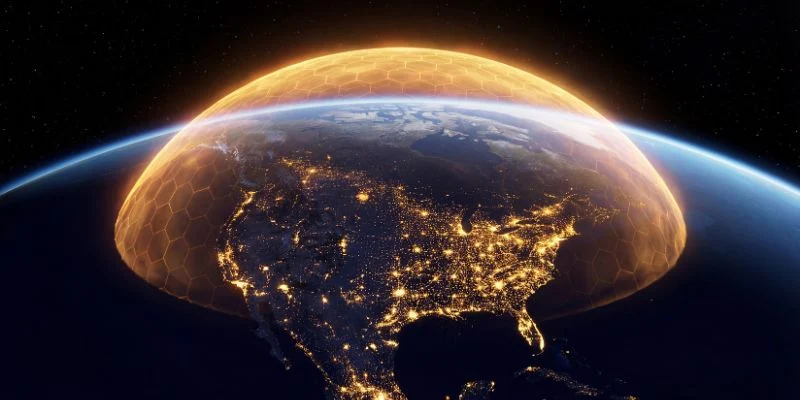
Given the threat posed to the homeland by adversaries such as Russia, China, Iran, and North Korea, President Trump aspires to create an integrated, multi-layered missile defense system. The concept called Golden Dome has garnered widespread attention from the Department of Defense (DOD), Congress, and stakeholders. While the idea is one that all can agree on, some questions need answers. This product aims to capture Golden Dome’s objective, function, cost, and practicality.
Golden Dome
Concept and Objective
Space News defined Golden Dome as a “proposed layered U.S. missile defense architecture intended to protect the homeland against ballistic, hypersonic and cruise missile threats by integrating ground-, air- and space-based sensors, interceptors and command-and-control systems into a unified network.” While it sounds like various existing options, like the Ground-Based Midcourse Defense (GMD) System, the Terminal High Altitude Area Defense System (THAAD), the Aegis Ballistic Missile Defense (BMD) System, and the Phased Array Tracking Radar to Intercept on Target (PATRIOT) Missile Defense System, the wording is important. The executive order calls for creating multiple layers of protection for the continental United States (CONUS), with each layer designed to handle different types of missile threats. Part of the Golden Dome concept involves upgrading existing missile defense systems and integrating them into a unified command. This structure mirrors Israel’s missile defense, which is a tiered missile defense system, with individual interceptor batteries covering different distances. For example, the famous Iron Dome is only the last part, covering low-altitude threats. Meanwhile, David’s Sling covers medium-range threats, Arrow 2 covers long-range threats, and Arrow 3 covers longer-range threats. With this, Golden Dome seeks to significantly increase coverage of existing U.S. defense systems, have each cover their respective tiers, and organize them into one command structure.
Executing Golden Dome’s objective will require coordination between U.S. Strategic Command (STRATCOM), U.S. Space Command (SPACECOM), and U.S. Northern Command (NORTHCOM).
Cost
The Golden Dome’s cost is unknown, with President Trump setting the cost at $175 billion. The Congressional Budget Office (CBO) predicted the system would cost about $542 billion, but the Chief of Space Operations, General B. Chance Saltzman, forecasted the Golden Dome would likely cost more than half a trillion dollars. However, Todd Harrison from the American Enterprise Institute (AEI) identified that accelerating programs that can begin fielding capabilities within the next three to five years would cost about $471 billion over 20 years. He also stated that investing in a space-centric strategic defense structure could cost roughly $2.4 trillion over 20 years. Given the wide range, it is evident Golden Dome will be an expensive, long-term endeavor.
Key Provisions
President Trump’s executive order (EO) titled “The Iron Dome For America” has two significant provisions. First is Section 3 (iii), which calls for the “development and deployment of proliferated space-based interceptors capable of boost-phase intercept.” This is significant because it calls for the U.S. to be able to intercept an incoming missile in the first missile flight phase, called the Boost Phase. During the Boost Phase, the missile is at its most vulnerable, as it is fired and traveling to space. The YouTube channel Real Engineering identified that the Golden Dome would need global interceptor coverage, which would be achieved by having weapons in space. More specifically, the U.S. would need to deploy a constellation of interceptors in low Earth orbit (LEO) to guarantee a successful boost-phase interception. The constellation interceptors would be able to track and discriminate targets, then respond instantly. However, there are several problems. First, it is unclear which interceptors would be deployed and how to deploy them. Second, Real Engineering states this would likely require between 1,300 and 2,000 LEO satellites, although this is feasible. The issue would be the sheer complexity of deployment and the cost. Real Engineering acknowledged that the U.S. could potentially use lasers for near-instant engagement, but this would require substantial amounts of power. The third problem is whether so many satellites and capabilities could be built in a short time frame, given that President Trump wants this to be done by the end of his term. The fourth problem would be international backlash, as other countries would protest the notion of the U.S. having weapons systems directly pointed down at them from space. Additionally, Russia and China possess anti-satellite weapons, which would pose a risk. If the U.S. successfully develops the Golden Dome’s capabilities, there is a risk of another arms race with adversaries like Russia and China, who will seek to protect and enhance their nuclear and conventional arsenals and work to penetrate U.S. defenses.
The second provision is Section 3 (iv), which orders the “development of underlayer and terminal-phase intercept capabilities postured to defeat a countervalue attack.” Countervalue targets are high civilian populations like cities, economic infrastructure, and areas of cultural importance. These attacks are meant to mentally crush an adversary by inflicting the maximum amount of damage possible on their society. With this, President Trump wants to ensure that the U.S. cannot suffer catastrophic damage in the wake of a nuclear or long-range conventional strike and be able to successfully strike incoming missiles in the last phase of a missile launch, the Terminal Phase, when warheads are diving to their intended targets.
Feasibility
There is debate about how realistic the Golden Dome would be. The Director of the Golden Dome, General Michael A. Guetlein, asserted that all the technology needed for the Golden Dome to operate already exists, as we possess early warning radars, sensors, surveillance assets, command-and-control (C2), missile defense systems, and interceptors. According to the Center for Strategic and International Studies’ (CSIS) Kari A. Bingen, “automation, artificial intelligence (AI), and advanced computing power will be central to its operational feasibility.”
Skeptics of Golden Dome cite that the physics is difficult to accomplish, as it is difficult to hit a fast-moving target that can deploy decoys or move out of the way of interceptors. The University of Michigan’s James Wells noted that in space, different objects of different masses travel at the same speeds. With this, target discrimination is harder as debris and decoys will be going just as fast as the warhead. Additionally, not all missiles are the same, as physicist and aeronautics engineer Paul Dimotakis stated, “different types of attacking missiles and their number and sophistication will require different tailored defenses.”
Another difficulty would be that the U.S. would need to have interceptors close to the launch sites, which would be impossible without adversaries knowing. While having constellations of satellites could help, ScienceNews recognized that 1,000 interceptors in orbit would be needed to protect against one North Korean intercontinental ballistic missile (ICBM). Therefore, thousands more orbit interceptors and many more satellites would be required to take out a handful of enemy missiles.
Conclusion
The Golden Dome is a highly advanced and aspirational concept to defend the U.S. from a variety of adversary missile attacks. While systems exist to protect the country and smaller regional zones, the size and scope of the Golden Dome would be far above current capacity. Although the idea and logic behind it are sound, the implementation will prove to be difficult in bringing together all systems under a unified command, with potentially thousands of moving pieces on the ground and in space. This effort will cost time and money, which the U.S. may or may not be able to pay, depending on the geostrategic landscape and the domestic political atmosphere.